Starting a fitness routine does not have to mean joining a gym or spending an hour exercising every day. Yoga for Beginners at Home is a simple, affordable way to improve flexibility, mobility, balance, and body awareness—even if you have never practiced yoga before.
With just 15 minutes a day, you can build a sustainable beginner yoga routine that fits around work, study, family responsibilities, or a busy lifestyle. The key is consistency, proper technique, and choosing yoga poses that match your current ability.
Important: Yoga can support general fitness and flexibility, but it is not a substitute for medical care. If you have an injury, significant pain, or a medical condition, consider speaking with a qualified healthcare professional before starting.
Why Is Yoga for Beginners at Home Worth Trying?
Yoga combines physical postures, controlled movement, breathing, and relaxation. For beginners, it can be an accessible form of physical activity because many poses can be modified to suit different fitness and flexibility levels.
A 2016 systematic review and meta-analysis published in Preventive Medicine found that yoga interventions were associated with improvements in several physical and psychological outcomes, although results varied depending on the type and duration of practice.
For someone starting at home, the biggest advantage is convenience.
You can practice:
- Without expensive equipment
- In a small amount of space
- At a time that suits your schedule
- Using beginner-friendly videos or routines
- Without worrying about your current fitness level
The goal is not to perform advanced poses. Your first goal should be to move comfortably and consistently.
What Do You Need for Yoga for Beginners at Home?
You do not need a dedicated yoga studio. A reasonably flat, comfortable surface is enough to begin.
A yoga mat can improve grip and cushioning, but it is not absolutely necessary.
Simple Equipment Checklist
- Yoga mat: Recommended for comfort and stability
- Comfortable clothing: Choose clothing that allows free movement
- Water: Keep yourself hydrated
- Towel or blanket: Useful for additional support
- Yoga blocks: Optional; books can sometimes provide support
Most importantly, choose a space where you can extend your arms and legs without hitting furniture.
What Are the Best Yoga Poses for Beginners?
If you’re completely new to yoga, begin with simple movements rather than attempting complicated inversions or extreme stretches.
Here are some beginner-friendly yoga poses to include in your routine.
1. Mountain Pose — Tadasana
Mountain Pose is a simple standing yoga position that helps you develop awareness of your posture and balance.
Stand with your feet comfortably apart, relax your shoulders, engage your core gently, and breathe slowly.
Hold for about 30–45 seconds.
2. Cat-Cow Stretch
Start on your hands and knees. Slowly round your spine while exhaling, then gently lift your chest and tailbone while inhaling.
This movement can help warm up your spine and prepare your body for the rest of your practice.
Repeat 6–8 slow cycles.
3. Child’s Pose — Balasana
Kneel comfortably and lower your hips toward your heels. Extend your arms forward and allow your upper body to relax.
If your knees or hips feel uncomfortable, place a folded blanket underneath you.
Stay for 30–60 seconds while breathing naturally.
4. Downward-Facing Dog — Adho Mukha Svanasana
From a hands-and-knees position, lift your hips upward and gradually straighten your legs as much as feels comfortable.
Beginners do not need to force their heels toward the floor.
Hold for approximately 20–30 seconds.
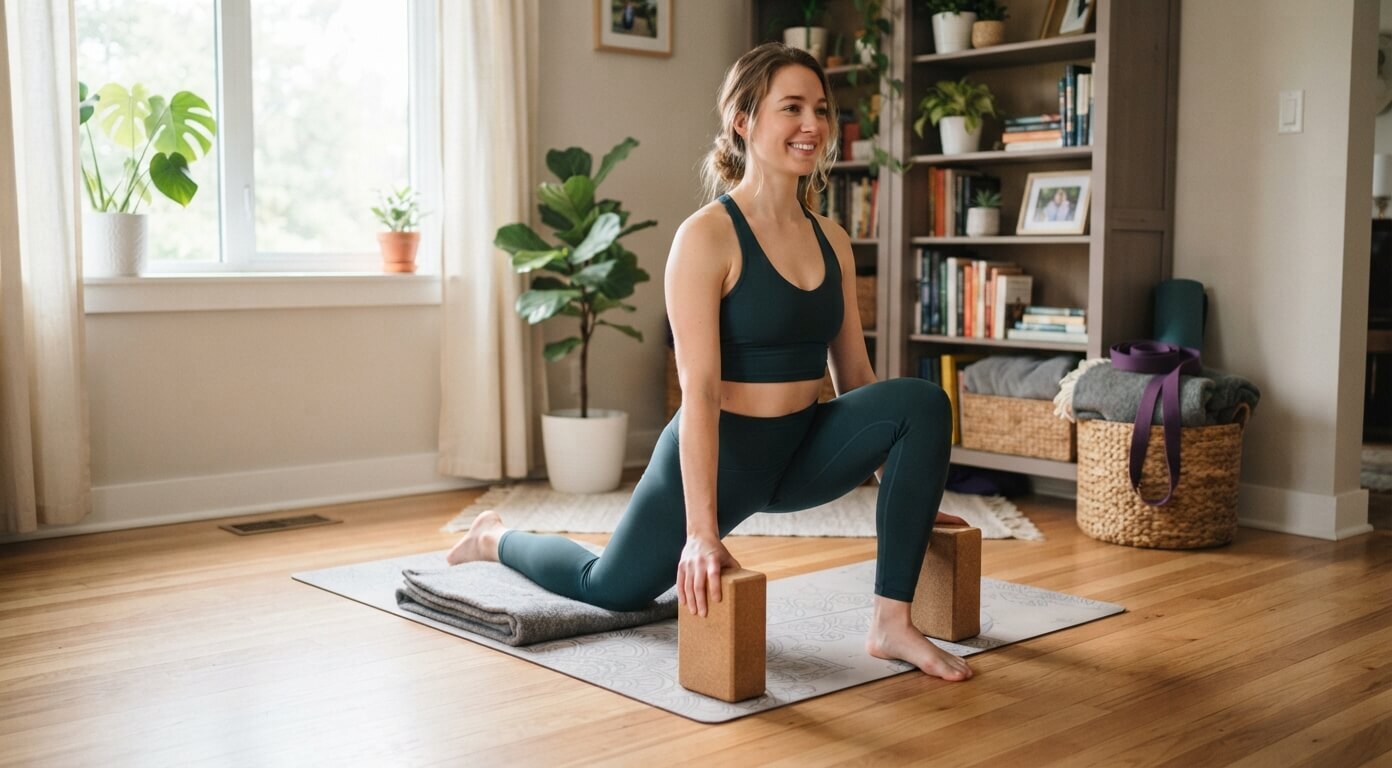
5. Low Lunge
Step one foot forward while keeping the opposite knee on the floor. Keep your chest lifted and gently shift your hips forward.
You should feel a comfortable stretch around the hip area—not sharp pain.
Hold each side for 20–30 seconds.
6. Cobra Pose — Bhujangasana
Lie on your stomach with your hands near your shoulders. Gently lift your chest while keeping the movement controlled.
Do not force your lower back into a deep bend.
Hold for 15–20 seconds, then relax.
7. Seated Forward Fold
Sit with your legs extended comfortably. Hinge forward from your hips and reach toward your legs without forcing yourself to touch your toes.
A slight bend in the knees is perfectly acceptable.
Hold for 20–30 seconds.
8. Corpse Pose — Savasana
Finish by lying comfortably on your back with your arms relaxed.
Close your eyes and take slow, comfortable breaths for 1–2 minutes.
Savasana gives you a calm ending to your beginner yoga routine.
What Is a Simple 15-Minute Beginner Yoga Routine?
A short routine is often easier to maintain than an ambitious program. Here’s a practical sequence you can repeat most days.
Your 15-Minute Yoga Routine
| Time | Yoga Position / Movement |
|---|---|
| 1 minute | Deep breathing + Mountain Pose |
| 2 minutes | Cat-Cow |
| 2 minutes | Child’s Pose |
| 2 minutes | Downward-Facing Dog |
| 2 minutes | Low Lunge — both sides |
| 2 minutes | Cobra Pose |
| 2 minutes | Seated Forward Fold |
| 2 minutes | Savasana |
Total: 15 minutes
Move slowly between positions. You should be able to breathe comfortably throughout the session.
If a particular pose causes pain, stop and modify or skip it.
Can You Do Yoga for Beginners at Home Every Day?
Yes, many people can practice gentle beginner yoga daily, particularly when the sessions focus on mobility, breathing, and comfortable movement.
However, daily yoga does not mean pushing your body to its maximum every day.
For example, you might structure your week like this:
- Monday: Full 15-minute routine
- Tuesday: Gentle stretching
- Wednesday: Full routine
- Thursday: Breathing + mobility
- Friday: Full routine
- Saturday: Gentle yoga
- Sunday: Rest or relaxation
Your body needs recovery, especially if you’re combining yoga with strength training, running, sports, or other demanding activities.
Beginners Yoga for Flexibility: What Should You Expect?
Flexibility develops gradually. If you cannot touch your toes today, that does not mean you are doing yoga incorrectly.
Begin with comfortable ranges of motion and gradually increase them as your body adapts.
For better flexibility:
- Warm up first.
- Avoid bouncing during stretches.
- Breathe slowly.
- Never force a joint beyond a comfortable range.
- Practice consistently.
- Use props when necessary.
A beginner may notice improved mobility before seeing dramatic changes in flexibility.
The objective is progress, not perfection.
Is Yoga for Beginners at Home Good for Weight Loss?
Yoga can contribute to an active lifestyle, but a 15-minute beginner session should not be viewed as a standalone weight-loss solution.
Weight management generally depends on factors such as overall calorie intake, physical activity, sleep, stress, genetics, and long-term habits.
If your goal is weight management, combine beginner yoga with other forms of movement.
For example:
- 15 minutes of beginner yoga
- 20–30 minutes of brisk walking
- Regular strength training
- A balanced eating pattern
- Adequate sleep
- Consistent daily activity
Yoga can be particularly useful as part of a broader lifestyle because it can help you establish a regular movement habit.
Yoga for Beginners Female: Is There a Different Routine?
There is no universal yoga routine that women must follow simply because they are women.
Yoga poses for beginners should primarily be selected according to your fitness level, mobility, comfort, and individual needs.
Women who are pregnant, recently postpartum, or dealing with a specific medical or musculoskeletal issue should seek appropriate professional guidance before beginning or modifying a yoga program.
The same principle applies to menstruation: comfort and individual preference should guide the intensity of practice.
Yoga for Beginners Male: Is Yoga Suitable for Men?
Absolutely. Yoga is not gender-specific.
Men who spend long hours sitting, exercising with weights, running, or participating in sports may use beginner yoga to work on mobility, balance, and body awareness.
If you are naturally tight, don’t compare your flexibility with someone else’s.
A good beginner practice should feel challenging but controlled, rather than painful.
Yoga for Beginners at Home Free: How Can You Start Without Spending Money?
One of the best things about Yoga for Beginners at Home Free routines is that you can start with almost no equipment.
You can use:
- A clean floor
- Comfortable clothes
- A towel or blanket
- A free beginner routine
- A timer
There is no requirement to purchase expensive clothing, accessories, or memberships.
However, when following online classes, choose instructors who explain alignment, modifications, breathing, and safety rather than simply demonstrating advanced poses.
What Should Beginners Avoid During Yoga?
Beginners sometimes make the mistake of treating yoga like a flexibility competition.
Avoid these common mistakes:
1. Forcing a stretch
Pain is not a sign that a pose is working correctly.
2. Holding your breath
Try to maintain relaxed, steady breathing.
3. Copying advanced practitioners
Your body may require different modifications.
4. Ignoring injuries
Modify or stop movements that aggravate an existing problem.
5. Practicing on an unsafe surface
Make sure your feet and hands have adequate grip.
6. Doing too much too soon
Consistency is more valuable than an intense session followed by several days of inactivity.
How Can You Make Your 15-Minute Yoga Habit Stick?
The most effective routine is one you can actually maintain.
Try these practical strategies:
- Practice at the same time each day.
- Keep your mat visible and ready.
- Start with only 15 minutes.
- Track your sessions on a calendar.
- Don’t abandon the routine after missing one day.
- Gradually increase duration when 15 minutes becomes comfortable.
- Pair yoga with an existing habit, such as morning coffee or an evening wind-down.
A simple mindset helps: “I only need to start.”
Once you begin, completing 15 minutes often feels much easier than deciding to exercise for an hour.
Your 15-Minute Yoga Plan at a Glance
If you want an easy beginner yoga routine to save, use this sequence:
- Mountain Pose — 1 minute
- Cat-Cow — 2 minutes
- Child’s Pose — 2 minutes
- Downward-Facing Dog — 2 minutes
- Low Lunge — 2 minutes
- Cobra Pose — 2 minutes
- Seated Forward Fold — 2 minutes
- Savasana — 2 minutes
Start gently, breathe naturally, and adjust poses according to your ability.
The purpose of Yoga for Beginners at Home is not to become flexible overnight. It is to create a sustainable movement practice that supports your overall physical and mental well-being.
Frequently Asked Questions
1. Is 15 minutes of yoga enough for beginners?
Yes. Fifteen minutes is a practical starting point for beginners. A short session can help you establish consistency and practice basic movements without feeling overwhelmed. As your fitness and confidence improve, you can gradually increase the duration or frequency of your sessions.
2. Which yoga poses should beginners learn first?
Beginners can start with simple poses such as Mountain Pose, Cat-Cow, Child’s Pose, Downward-Facing Dog, Low Lunge, Cobra Pose, Seated Forward Fold, and Savasana. Focus on comfortable movement and proper breathing rather than achieving advanced positions.
3. Can beginners do yoga at home without an instructor?
Yes. Beginners can practice basic yoga at home using reliable instructional resources. However, pay attention to technique, choose beginner-level sessions, and stop any movement that causes sharp or unusual pain. Professional instruction can be particularly valuable if you have an injury or specific physical limitation.
4. Can yoga help beginners become more flexible?
Yes. Consistent yoga practice can help improve flexibility and range of motion for many people. Results vary between individuals, so avoid comparing your flexibility with others. Gentle, regular practice is generally more useful than aggressively forcing stretches.
5. Can I lose weight with yoga for beginners at home?
Yoga can be part of a healthy weight-management lifestyle, but a short beginner session alone is unlikely to produce major weight loss. Combine yoga with regular physical activity, a balanced diet, adequate sleep, and sustainable lifestyle habits for a more comprehensive approach.